Hot Springs Range Project

Deposit Type

Carlin-type Au
Low-sulfidation epithermal Au

Historic Production/Resource

NA

Geology

Mississippian-age calcareous sediments and andesites thrust over Permian phyllites. Host rocks coincide w/ crustal-scale subvertical faults.

Land Package

4,311 Ha

Exploration Target

Open-pit gold (oxide)

Geochemistry

Soil sampling, 
Surface rock chips

Mapping

1:10,000 scale geologic map

Previous Explorers

NA

Geophysics

CSAMT, Gravity

Drilling

4 Core Holes Completed

Permitting

BLM Notice Level (Otis)
BLM Notice Level (Eden)

Key Statistics: Property Location, Size and Exploration Maturity

The project area is in northern Humboldt County, Nevada, and comprises 521 federal lode claims on BLM land, totaling 4,311 hectares. It is located 50 km northeast of Winnemucca, NV, and 15 km northwest of Nevada Gold Mines’ Turquoise Ridge Complex in the Getchell Trend. The prospect lies within the Poverty Peak mining district, where minor mercury and antimony production occurred primarily east of HSRP (Bailey and Phoenix, 1944). While there has been limited gold exploration in the area (Master, 2017), there is no evidence that any other company recognized or followed up on the regional concept that led Milliard Geological Consultants (MGC) to stake the property (see Discovery section below). Eminent has completed the option agreement with MGC and now controls the known portion of this emerging Carlin‑style trend through its district‑scale HSRP land package. In May 2025, Kinross became early‑stage investors in Eminent and recently staked additional claims to the north of HSRP.
Overview of the Opportunity

The Hot Springs Range Project has progressed from a completely unknown, untested target to the first new stand‑alone Carlin‑type oxide gold discovery since the Cortez Hills deposit in 2003 (Hays, 2004). As such, it represents an opportunity to create value in the only new trend emerging within an otherwise mature gold region. The Carlin districts of Nevada host one of the highest concentrations of large gold deposits on Earth, with 255 Moz of endowment and approximately 5% of global annual gold production (4.5 Moz; Muntean, 2020). A newly identified Carlin‑type trend is therefore both unique and highly valuable.

Eminent recently released a core drill intercept of 9.2 meters grading 3.2 g/t Au, hosted in deformed mafic volcanics and limestone—lithologies and deformation styles similar to key host units in the Getchell Trend (Figure 2), which has 28 Moz of production, 20 Moz M+I at 5.4 g/t, and 1.6 Moz inferred at 3.2 g/t.

Turquoise Ridge—containing 7.1 Moz at 10 g/t (underground) and 1.8 Moz at 2.1 g/t (surface) as of year‑end 2024 (Fiddes et al., 2025)—is the closest Carlin‑type gold mine to HSRP and exhibits similar structural controls (intersection of NE‑ and NW‑trending structures; Figures 1, 2) and comparable host lithologies.

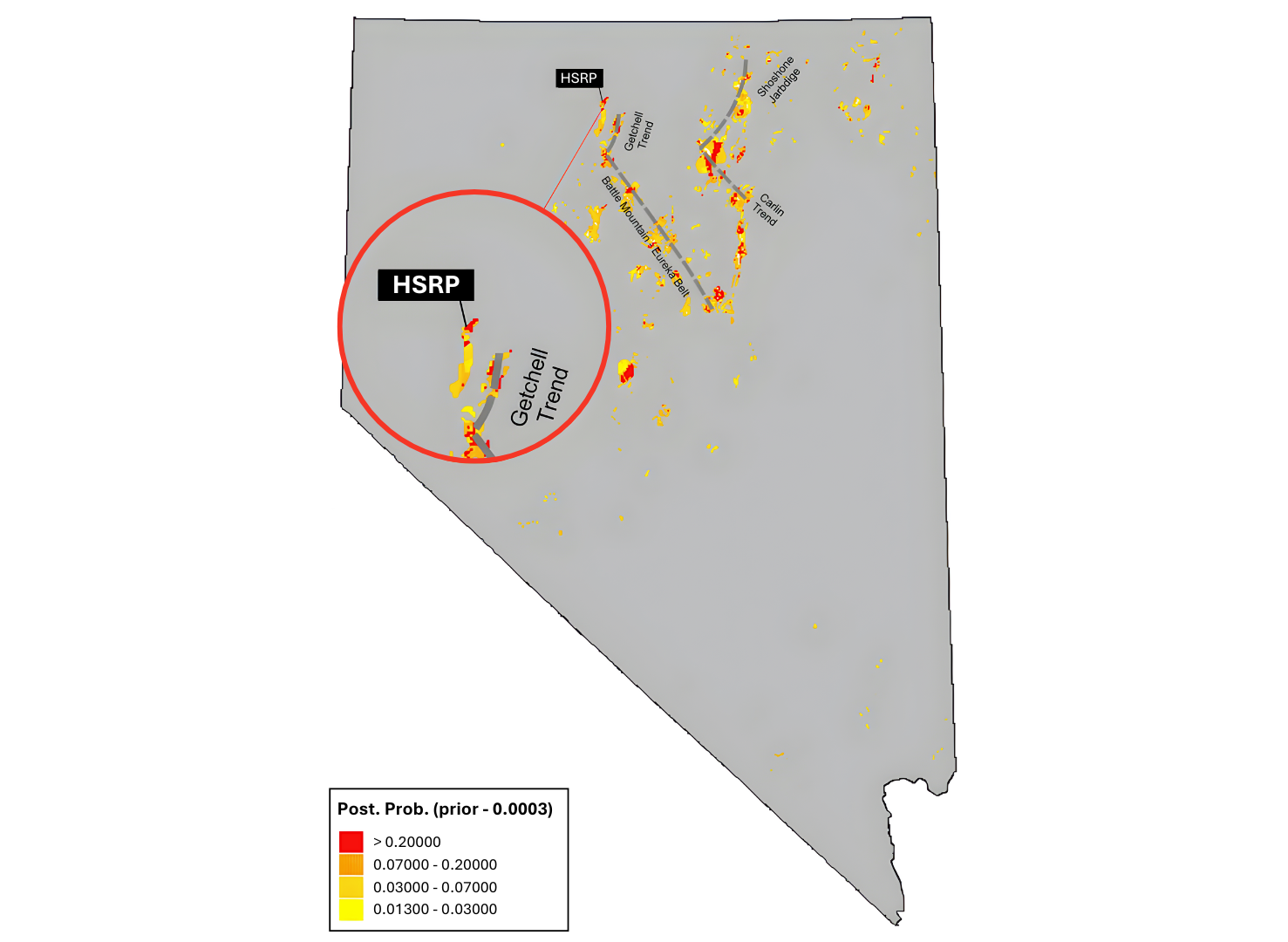
HSRP contains the northernmost exposure of Paleozoic rocks in the region, one of the key reasons the USGS identifies the area as highly prospective for Carlin‑type mineralization (Figure 3) (Mihalasky, 1999; Mihalasky, 2001), placing it within a zone ranked highest for mineral potential. The fact that this intersection of major mineralized belts, combined with highly prospective host rocks, had never been systematically explored is remarkable. The Company’s subsequent success is now providing confirmation of the district’s potential.

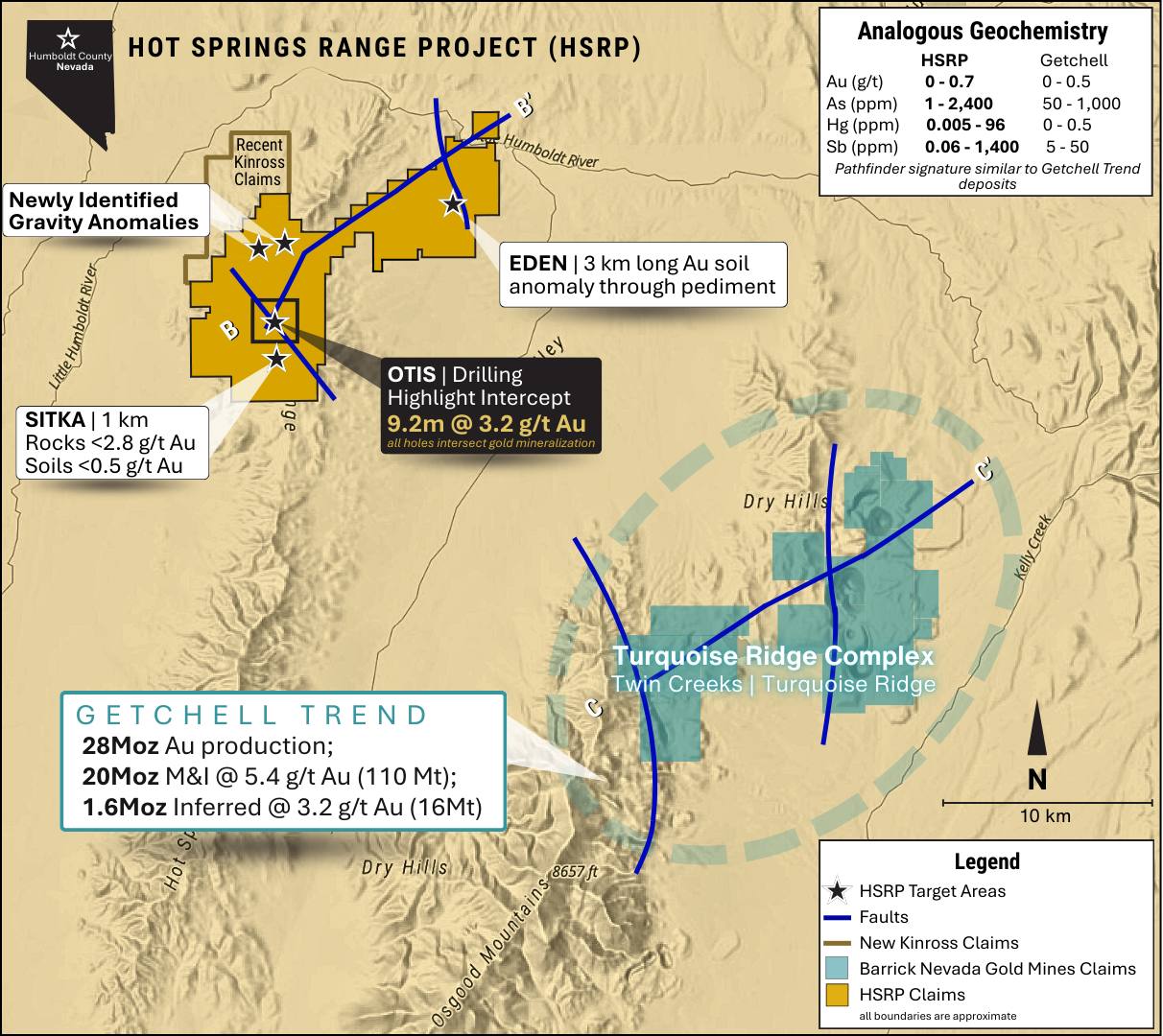
Figure 1. Relief map of north‑central Nevada showing the Getchell Trend gold endowment (Fiddes et al., 2025), the relative positions of the Turquoise Ridge Complex and the Hot Springs Range Project (“HSRP”), the prospects developed at HSRP, the similarity of structural corridors, anomalous geochemistry near mineralization at HSRP, and Eminent’s recent intercept at the Otis prospect. Major fault architecture at Getchell is from Hays (2019).Figure 1. Relief map of north‑central Nevada showing the Getchell Trend gold endowment (Fiddes et al., 2025), the relative positions of the Turquoise Ridge Complex and the Hot Springs Range Project (“HSRP”), the prospects developed at HSRP, the similarity of structural corridors, anomalous geochemistry near mineralization at HSRP, and Eminent’s recent intercept at the Otis prospect. Major fault architecture at Getchell is from Hays (2019).

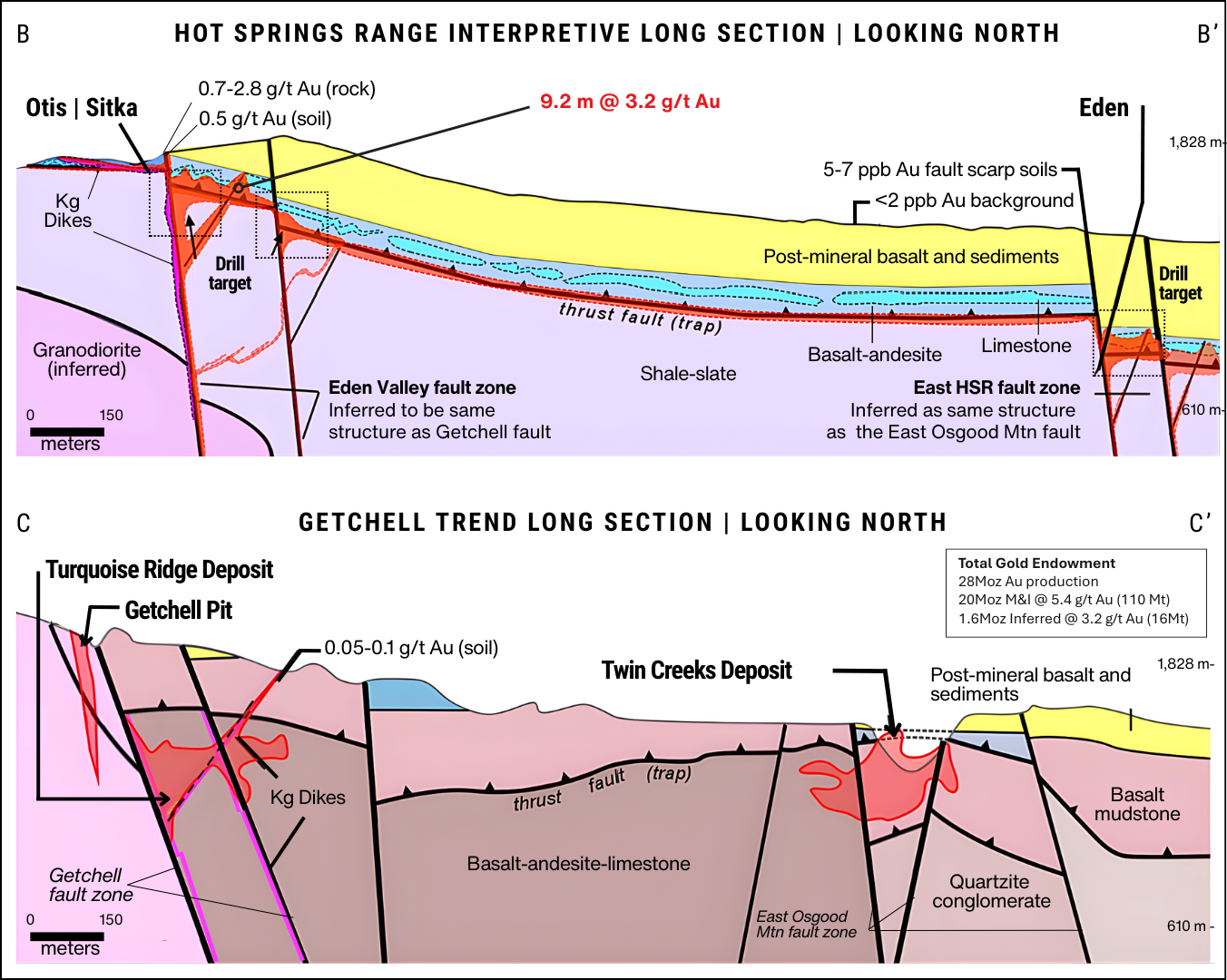
Figure 2. Long sections of HSRP and Getchell (after Hays, 2018, and Muntean et al., 2009) showing section traces B–B’ and C–C’ from Figure 1. The geochemistry for the Getchell Trend above the ore bodies is from Johnson and Muntean (2018). These sections illustrate the hypothesis that HSRP resembles the Getchell Trend in its most important attributes: deep‑seated structures, thrust faults, and permissive host rocks.Figure 2. Long sections of HSRP and Getchell (after Hays, 2018, and Muntean et al., 2009) showing section traces B–B’ and C–C’ from Figure 1. The geochemistry for the Getchell Trend above the ore bodies is from Johnson and Muntean (2018). These sections illustrate the hypothesis that HSRP resembles the Getchell Trend in its most important attributes: deep‑seated structures, thrust faults, and permissive host rocks.

Figure 3. Plan‑view map of the eight‑layer mineral potential model modified from Mihalasky (2001). Areas predicted to have the highest mineral potential correspond to known deposits along major mineral belts and trends (dashed gray lines). The HSRP coincides with a zone of highest mineral‑potential favorability (red areas) for Carlin‑type gold mineralization. Mihalasky (2001) rates the Hot Springs Range highly in part because it contains permissive Paleozoic host rocks.

Discovery Concept

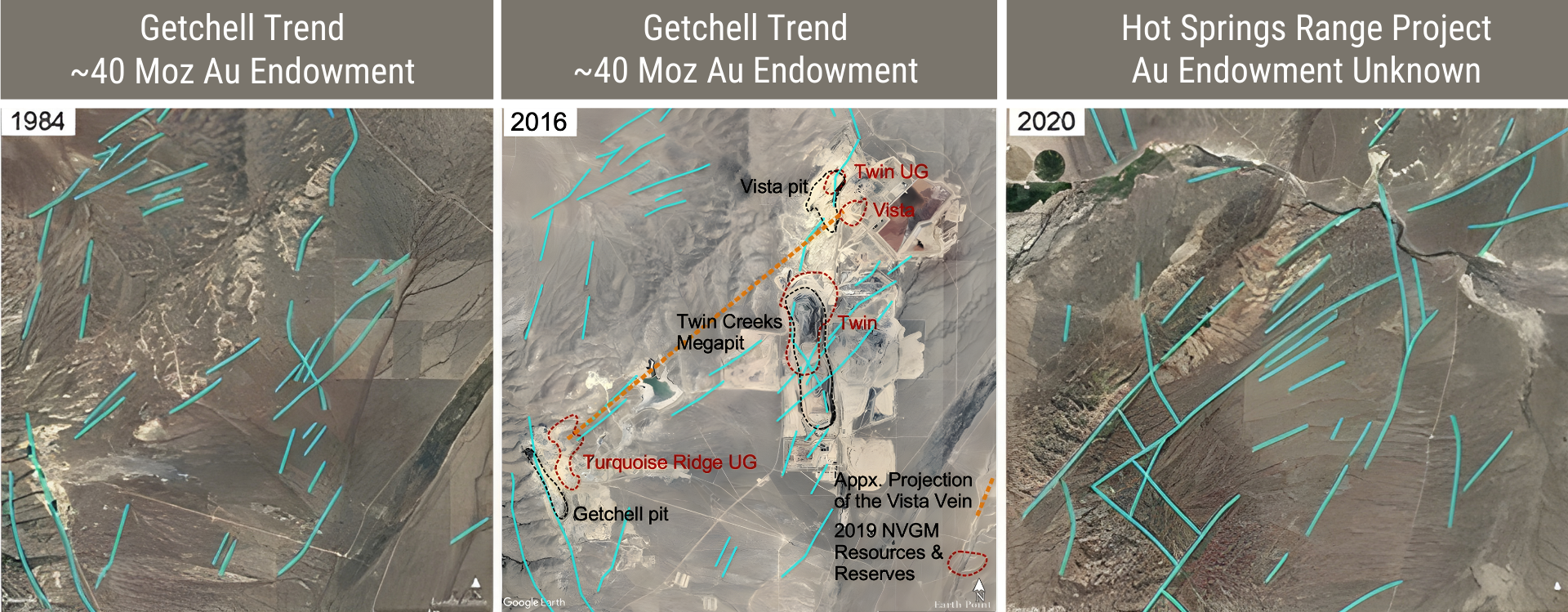
The discovery concept developed by Milliard Consulting Group—and the basis for staking the property before optioning it to Eminent—was that long‑lived faults in north‑central Nevada were reactivated during mineralization and remain active today (Muntean et al., 2018). This framework suggested that air‑photo interpretation across both bedrock and pediment could be used to identify these persistent structures. During the Carlin mineralization event, ore‑forming fluids migrated upward along these structures and, where favorable host lithologies were present, deposited large Carlin‑style gold systems (Figure 4).

Since acquiring the property, the Company has confirmed its prospectivity at every stage—through mapping, geochemistry, geophysics, and, subsequently, drilling. It has identified what it believes to be two well‑defined drill targets: Otis, which has already delivered a substantial intercept (Figure 1), and Eden, which is scheduled for drilling in 2026.

Figure 4. A comparison of the Getchell and Hot Springs air photos and interpreted lineations with the same scale and orientation show Tertiary-Quaternary age faults (blue) that are reactivated on Paleozoic-age fault fabric. Left) Historic 1984 era air photos of the Getchell Trend showing faults. Center) Recent (ca. 2016) imagery of the Getchell Trend showing correlation of active mines and structures.  Right) Recent (ca. 2020) air photos of the Hot Springs Range Project showing lineations. In both instances, the intersection of NE and NW or NS faults controls mineralization.Figure 4. Comparison of air photos and interpreted lineations from the Getchell Trend and the Hot Springs Range Project (HSRP), shown at the same scale and orientation. Blue lineations represent Tertiary–Quaternary‑age faults reactivated along Paleozoic‑age structural fabric. Left: Historic 1984 air photos of the Getchell Trend showing mapped faults. Center: Recent (ca. 2016) imagery of the Getchell Trend illustrating the correlation between active mines and major structures. Right: Recent (ca. 2020) air photos of the Hot Springs Range Project showing interpreted lineations. In both districts, the intersection of NE‑trending and NW‑ or N‑S‑trending faults controls mineralization.

Regional Geology

The geology of north‑central Nevada is highly complex, reflecting a long and varied geologic history (Milliard and Schranz, 2021). As noted in the previous section, the persistence of long‑lived faults — still recognizable today — highlights a history defined by repeated cycles of passive‑margin sedimentation followed by orogenic compression that produced extensive fold‑and‑thrust terranes. Subsequent back‑arc extension and Eocene magmatism provided the heat needed to reactivate earlier faults and drive large volumes of hydrothermal fluid flow. These fluids mobilized metals and moved through both reactivated structures and newly formed extensional faults, allowing them to permeate the crust and interact with reactive volcanic and sedimentary rocks that had been strongly folded and thrusted during earlier orogenic events.

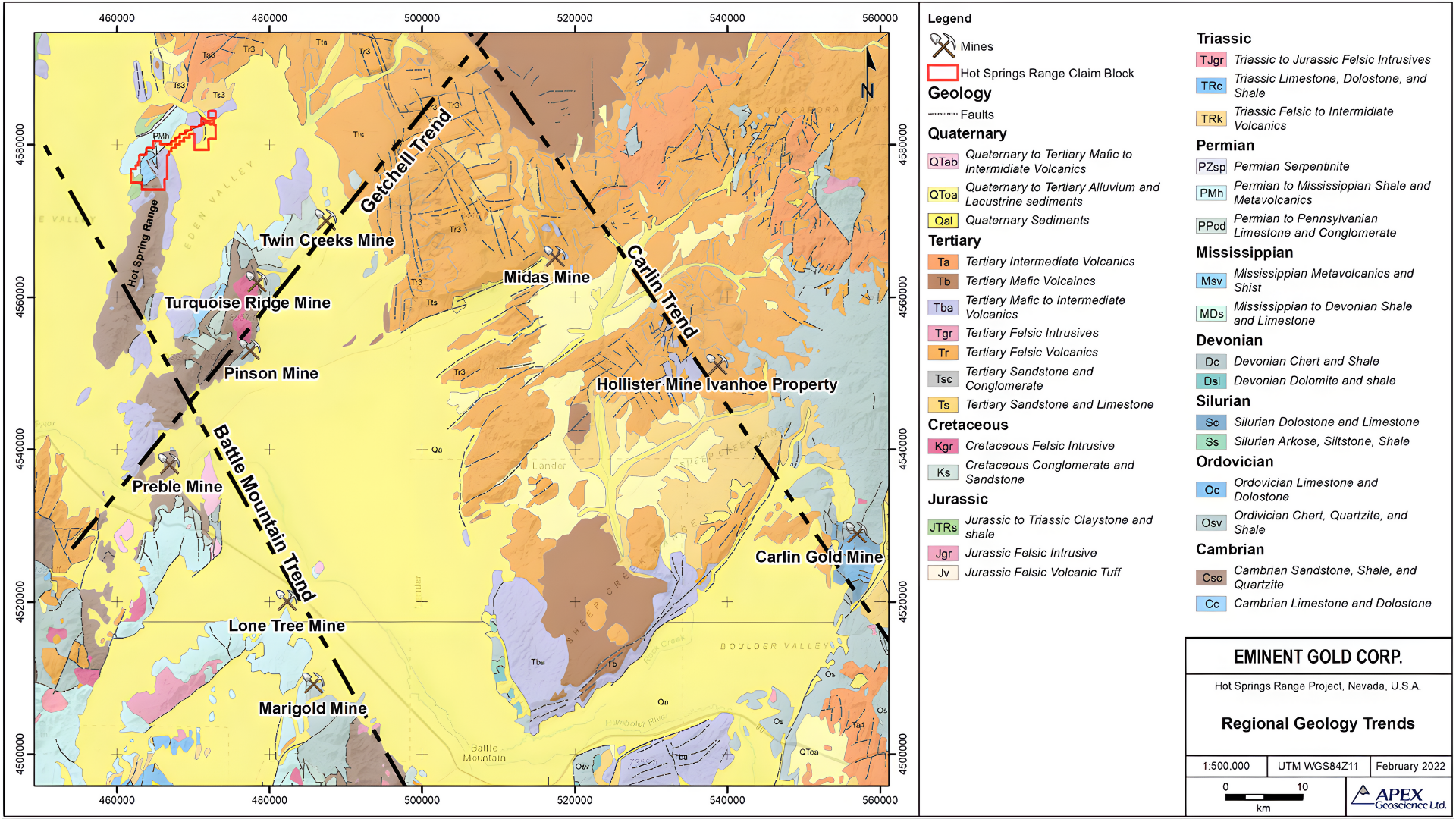
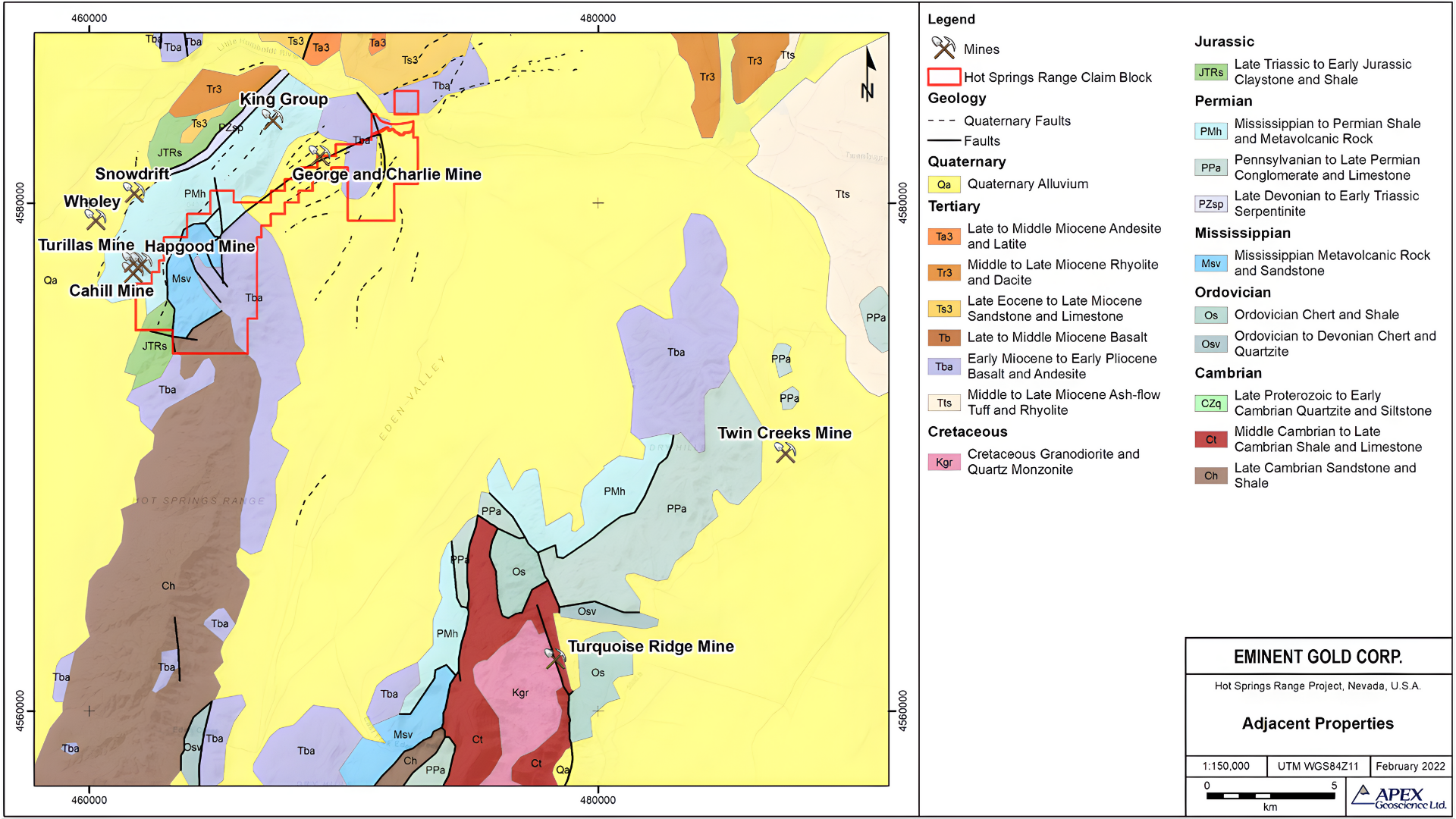
Following mineralization, post‑mineral extension shaped the Basin and Range physiography of Nevada and generated rift systems that produced basaltic magmatism and, locally, high‑grade low‑sulfidation vein deposits such as Midas and Fire Creek (Figures 5, 6, 7). Thus, exploration targeting requires identifying both the right structures and the right host rocks (Figure 8).

Figure 5. Regional Geology of the Hot Springs Range Property showing the Getchell Trend and northern portion of the Carlin and Battle Mountain structural trends. The HSRP claim boundary is that established prior to claim expansion in 2025. (Dufresne, 2020)Figure 5. Regional geology of the Hot Springs Range Property showing the Getchell Trend and the northern portions of the Carlin and Battle Mountain structural trends. The HSRP claim boundary shown reflects the extent of the property prior to the 2025 claim expansion (Dufresne, 2020).

Figure 6. Regional Geology of the Hot Springs Range Property showing the Getchell Trend The HSRP claim boundary is that established prior to claim expansion in 2025. (Dufresne, 2020)Figure 6. Regional geology of the Hot Springs Range Property showing the Getchell Trend. The HSRP claim boundary shown reflects the extent of the property prior to the 2025 claim expansion (Dufresne, 2020).

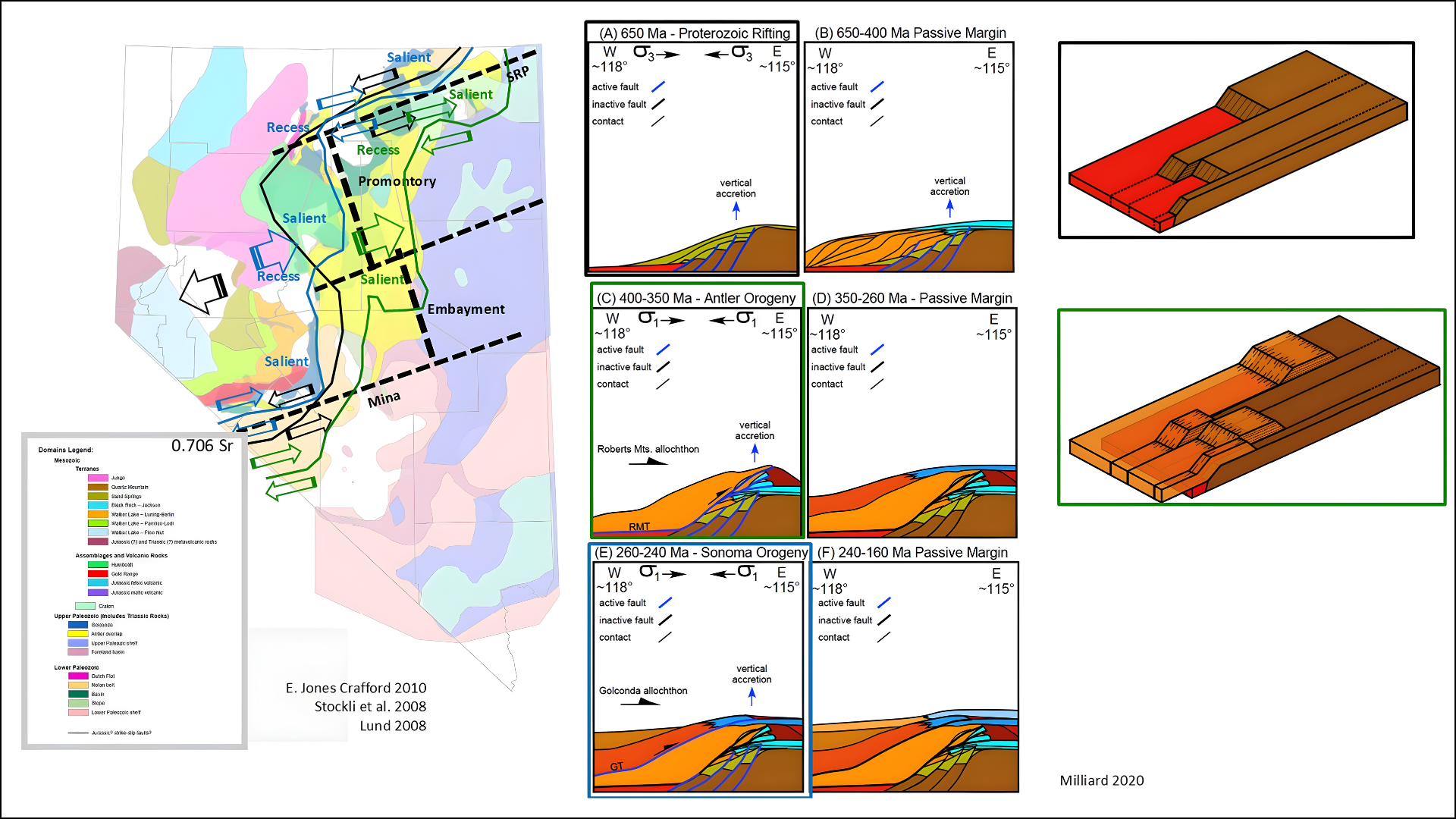
Figure 7A. Capsule geologic history of north‑central Nevada (Milliard and Schranz, 2021). The plan views on the left show relative fault motion and the positions of major geologic domains in eastern Nevada during deposition of Paleozoic sediments. The cross‑sections on the right illustrate: A) 650 Ma, Proterozoic rifting; B) 650–400 Ma, passive margin and development of transform faults; C) 400–350 Ma, Antler Orogeny; D) 350–260 Ma, passive margin; E) 260–240 Ma, Sonoma Orogeny; F) 240–160 Ma, passive margin.Figure 7A. Capsule geologic history of north‑central Nevada (Milliard and Schranz, 2021). The plan views on the left show relative fault motion and the positions of major geologic domains in eastern Nevada during deposition of Paleozoic sediments. The cross‑sections on the right illustrate: A) 650 Ma, Proterozoic rifting; B) 650–400 Ma, passive margin and development of transform faults; C) 400–350 Ma, Antler Orogeny; D) 350–260 Ma, passive margin; E) 260–240 Ma, Sonoma Orogeny; F) 240–160 Ma, passive margin.

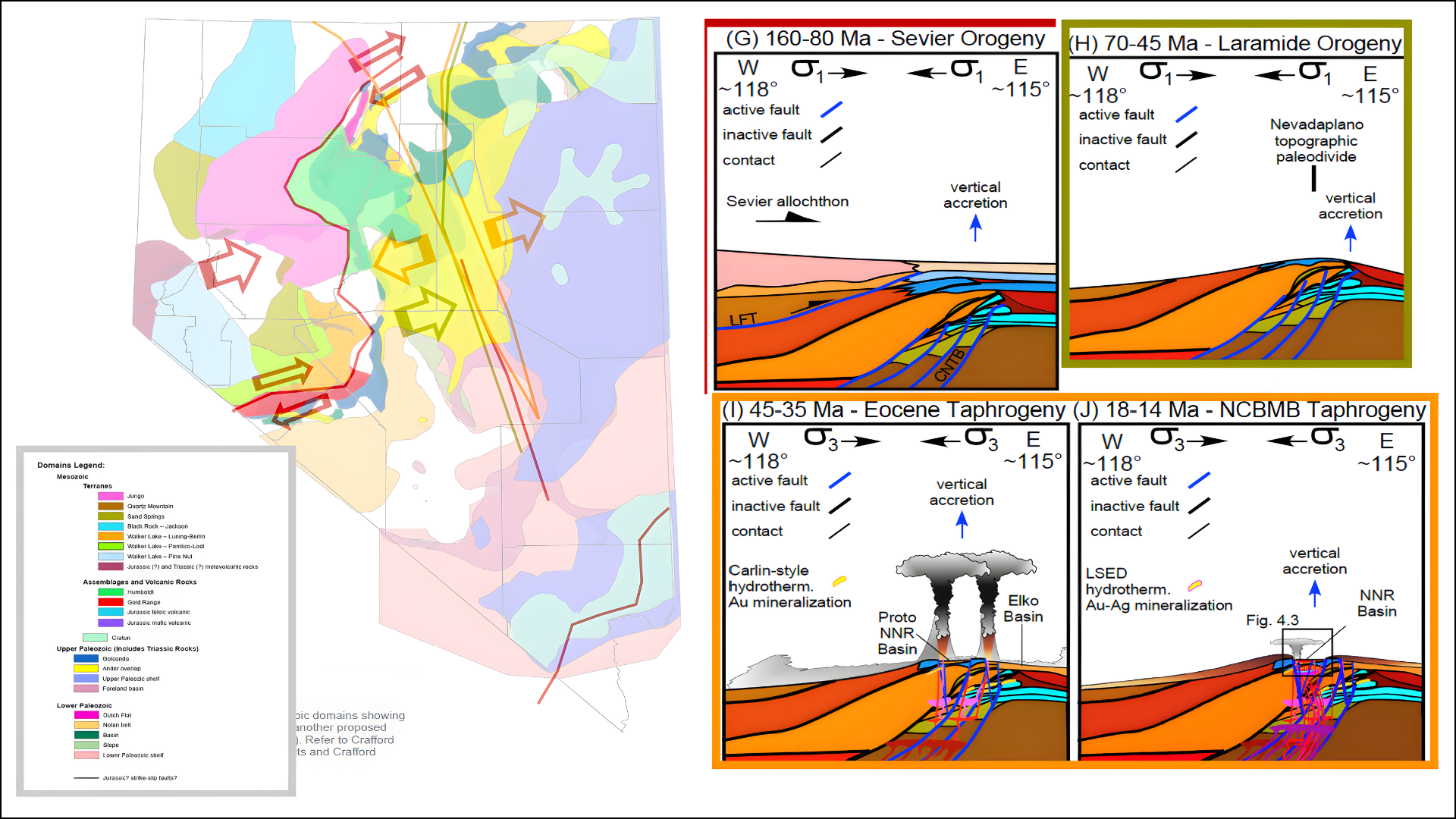
Figure 7B. Capsule geologic history of north‑central Nevada (Milliard and Schranz, 2021). The plan view on the left shows relative fault motion and the positions of major geologic domains before and during the Tertiary rifting event. The cross‑sections on the right illustrate: G) 160–80 Ma, Sevier Orogeny; H) 70–45 Ma, Laramide Orogeny; I) 45–35 Ma, Eocene back‑arc rifting and Carlin deposit formation; J) 18–14 Ma, continental rifting and the creation of the Basin and Range Province.Figure 7B. Capsule geologic history of north‑central Nevada (Milliard and Schranz, 2021). The plan view on the left shows relative fault motion and the positions of major geologic domains before and during the Tertiary rifting event. The cross‑sections on the right illustrate: G) 160–80 Ma, Sevier Orogeny; H) 70–45 Ma, Laramide Orogeny; I) 45–35 Ma, Eocene back‑arc rifting and Carlin deposit formation; J) 18–14 Ma, continental rifting and the creation of the Basin and Range Province.

Property Geology, Hydrothermal Alteration and Geochemistry

As shown in Figures 1 and 2, the potential of the HSRP project was first recognized through its structural similarity to the Getchell Trend and confirmed by statistical analysis (Figures 2–4). However, a Carlin‑type system also requires a suitably reactive host rock and significant pre‑mineral deformation to create pathways for hydrothermal fluids.

The geology of the HSRP property (Figure 8) consists of late Paleozoic rocks that have been extensively deformed. The Home Ranch Terrane (HRT) contains lenses of basaltic andesite interlayered with large boudins of limestone. This combination provides both the iron‑rich volcanic component and the carbonate material released from decalcified limestone veins, which subsequently permeated the volcanic rocks.

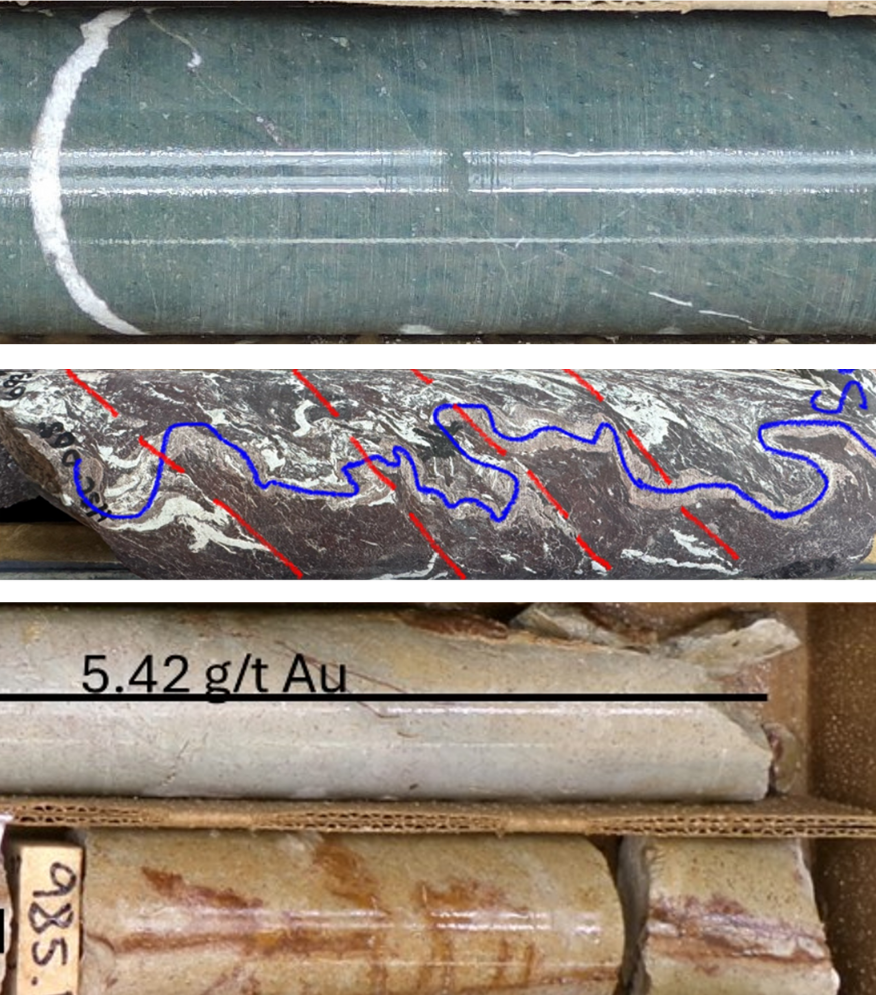
Figure 9 illustrates the extensive alteration associated with gold mineralization in the volcanic unit of the HRT. Decalcification of calcite veins, followed by replacement with silica and illite/sericite, is characteristic of Carlin‑style gold mineralization and is well developed in this unit.

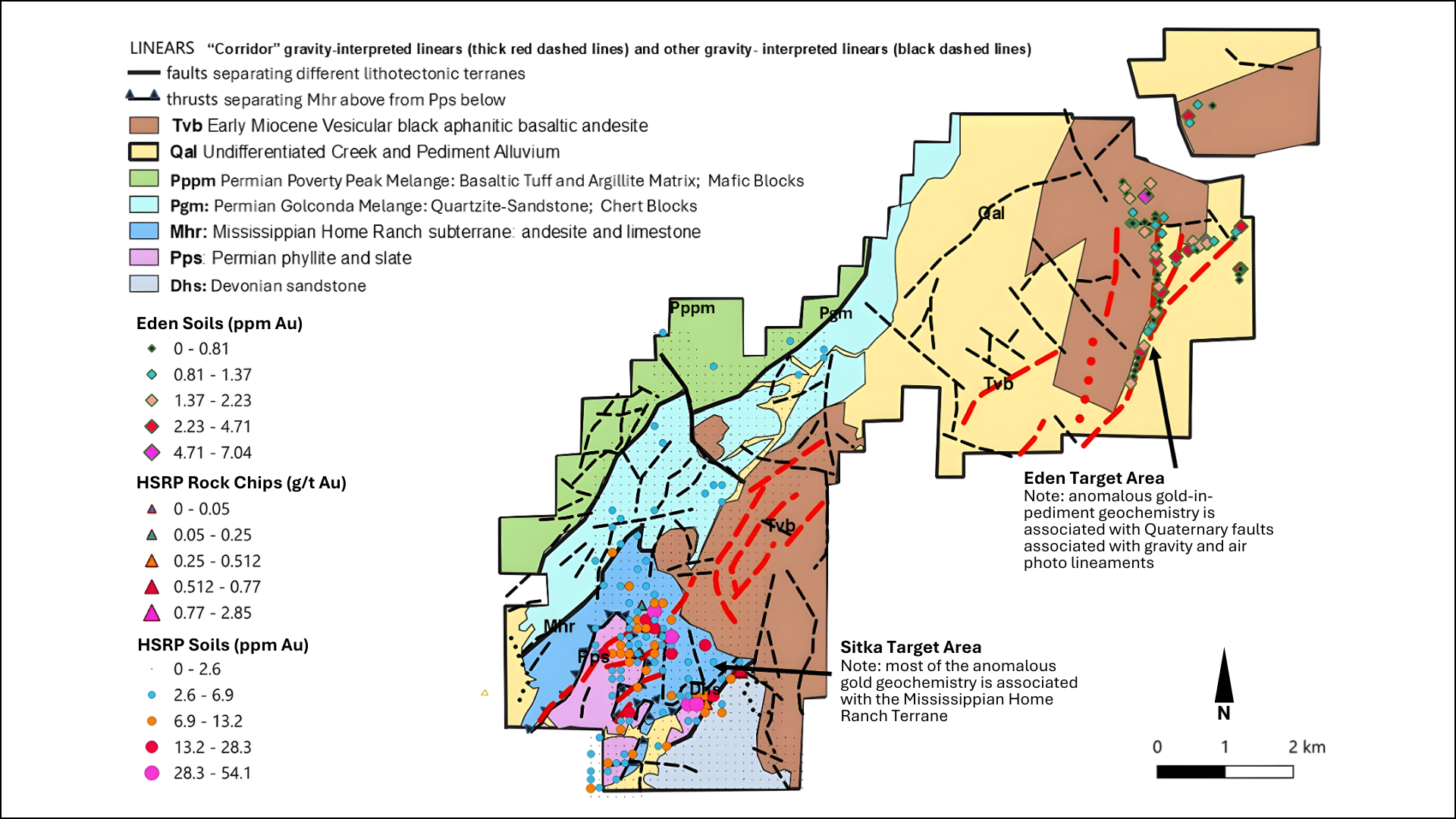
Figure 8. Simplified geologic map of the HSRP after Jones (1997), showing the major Paleozoic lithotectonic units along with post‑mineral Miocene basalt and alluvium. The structures separating the terranes are shown and are interpreted by Jones as steeply dipping, except for the Mississippian Home Ranch Terrane, which lies in a low‑angle thrust contact above the younger Permian phyllite. The folding and deformation observed in HRT drill core are consistent with this interpretation.Figure 8. Simplified geologic map of the HSRP after Jones (1997), showing the major Paleozoic lithotectonic units along with post‑mineral Miocene basalt and alluvium. The structures separating the terranes are shown and are interpreted by Jones as steeply dipping, except for the Mississippian Home Ranch Terrane, which lies in a low‑angle thrust contact above the younger Permian phyllite. The folding and deformation observed in HRT drill core are consistent with this interpretation.

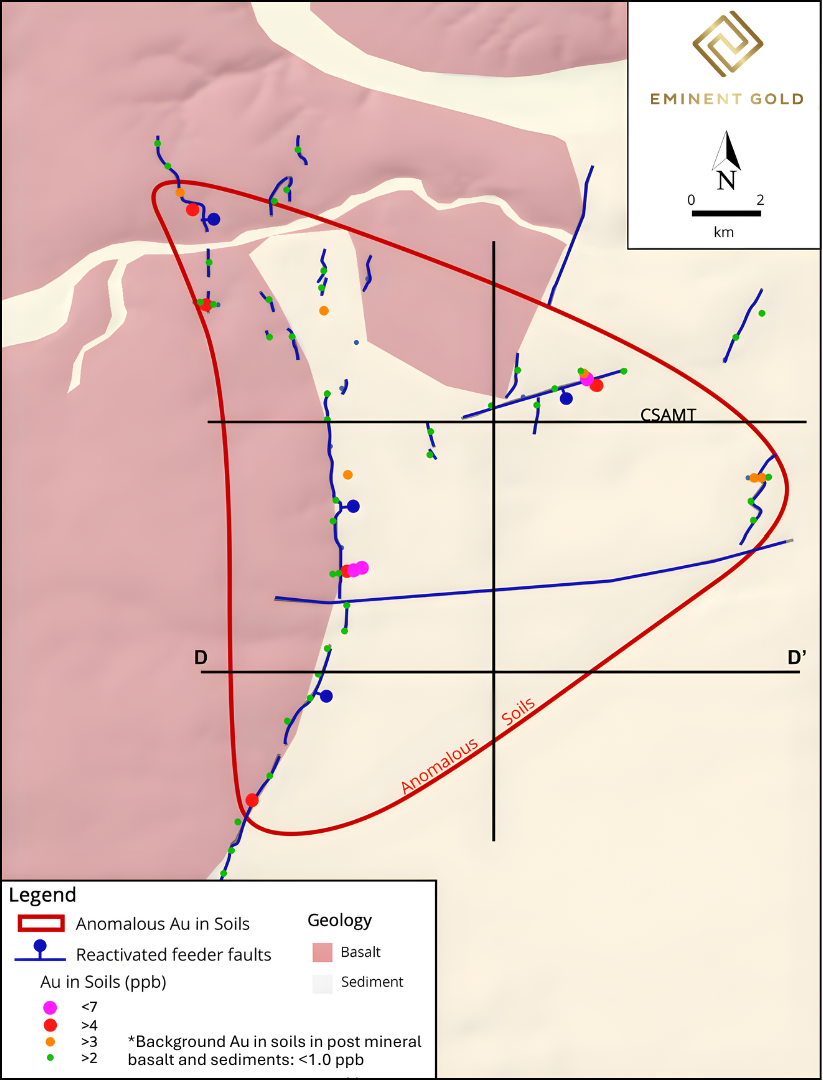
The geochemistry shown consists of soil and rock samples collected across the western portion of the property, with most anomalies occurring within the HRT. Pediment soils were collected at the Eden prospect in the eastern portion of the property, where Paleozoic rocks are covered by post‑mineral basalt and alluvium. A notable Quaternary fault system aligned with the alluvium–basalt contact was identified in air photos and confirmed in the field by fault scarps and mud volcanoes. This structure is further supported by linears interpreted from gravity offsets and is also anomalous in gold,

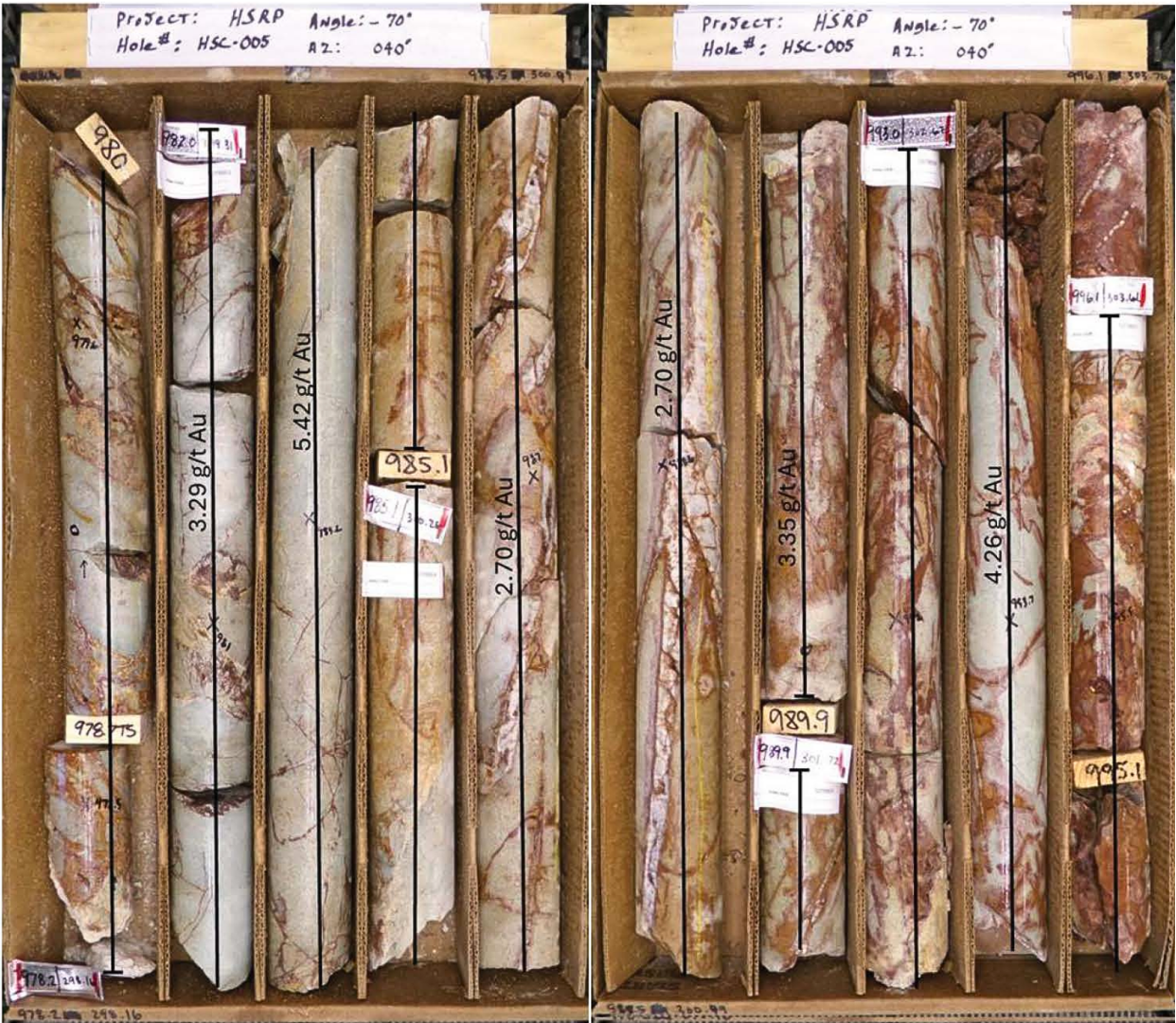
Figure 9:  Photos of variably altered volcanic rocks of the Mississippian Home Ranch Terrane. Top photo is less altered andesitic basalt brecciated basalt with chlorite alteration and minor calcite veining.  Middle photo is ductile deformation and alteration of the volcanic rock during a folding and thrusting event that probably took place during the Antler and Sevier orogenies.   This event introduced abundant calcite and hematite into the rock. Bottom Photo is the ore phase where the volcanic rock that was previously full of calcite veins and hematite is decalcified: Silica and illite/sericite replace the calcite and destroy the matrix of the original volcanic rock.  The interval that assayed 5.42 g/t Au has no quartz veins in it. Figure 9. Photos of variably altered volcanic rocks of the Mississippian Home Ranch Terrane (HRT). The top photo shows less‑altered andesitic basalt and brecciated basalt with chlorite alteration and minor calcite veining. The middle photo shows ductile deformation and alteration of the volcanic rock during folding and thrusting, likely associated with the Antler and Sevier orogenies. This event introduced abundant calcite and hematite into the rock. The bottom photo represents the ore phase, where volcanic rocks previously filled with calcite veins and hematite have been decalcified. Silica and illite/sericite replace the calcite and destroy the original volcanic matrix. The interval that assayed 5.42 g/t Au contains no quartz veins.

Regional Geophysics: Gravity

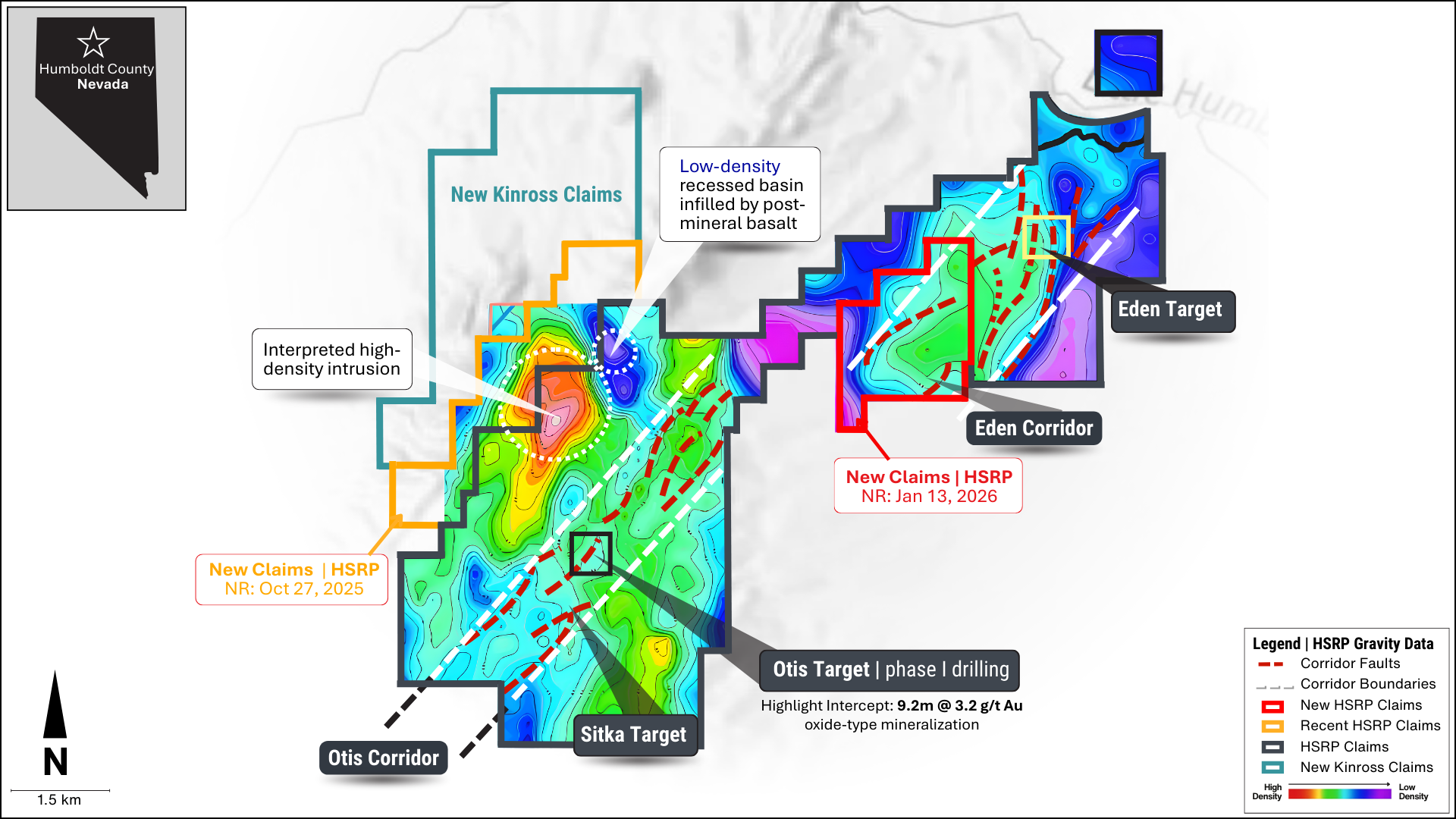
Eminent conducted a geophysical survey in 2025, which was interpreted by Jim Wright, who has over 40 years of experience interpreting geophysics for Carlin‑trend explorers in Nevada, including Newmont Corp. The gravity data show displacements at depth that define through‑going NE‑trending structures in both the Otis and Eden corridors, as well as additional high‑ and low‑gravity targets to the north (Figure 9).

Figure 10. Map of contoured, topography‑corrected gravity geophysics, with dark colors representing low‑density areas and bright colors representing high‑density areas. Jim Wright selected targets based on the pronounced, through‑going NE‑trending structures in the Otis and Eden corridors, as well as additional high‑ and low‑density targets to the north. The high‑density target likely represents an intrusion, a feature commonly associated with Carlin trends, while the low‑density target may indicate a hidden graben. The geophysical results led Eminent to stake new claims in both the northeastern area (where Kinross also staked claims) and the south‑central portion of the property.Figure 10. Map of contoured, topography‑corrected gravity geophysics, with dark colors representing low‑density areas and bright colors representing high‑density areas. Jim Wright selected targets based on the pronounced, through‑going NE‑trending structures in the Otis and Eden corridors, as well as additional high‑ and low‑density targets to the north. The high‑density target likely represents an intrusion, a feature commonly associated with Carlin trends, while the low‑density target may indicate a hidden graben. The geophysical results led Eminent to stake new claims in both the northeastern area (where Kinross also staked claims) and the south‑central portion of the property.


Targeted Geophysics: CSAMT

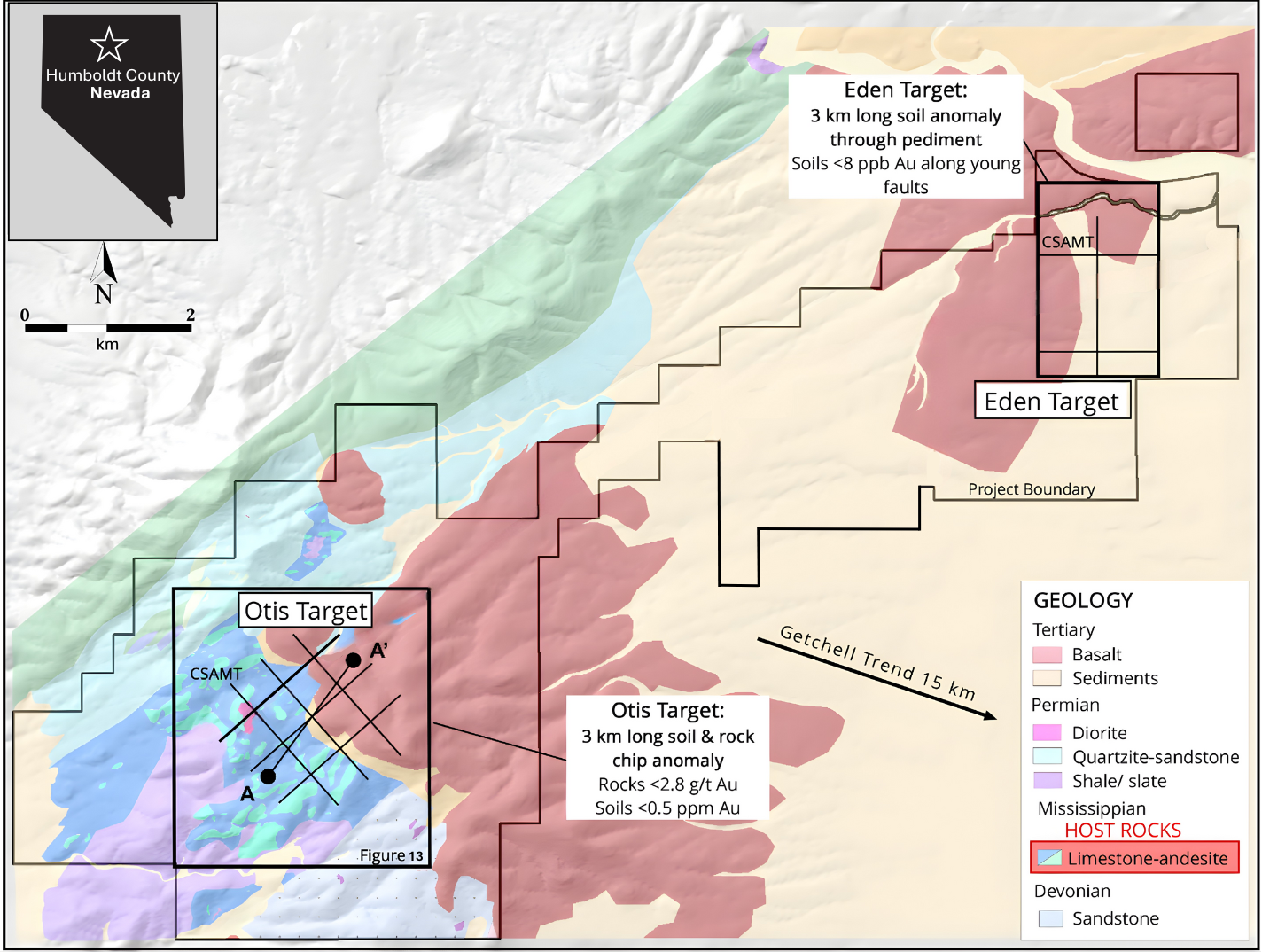
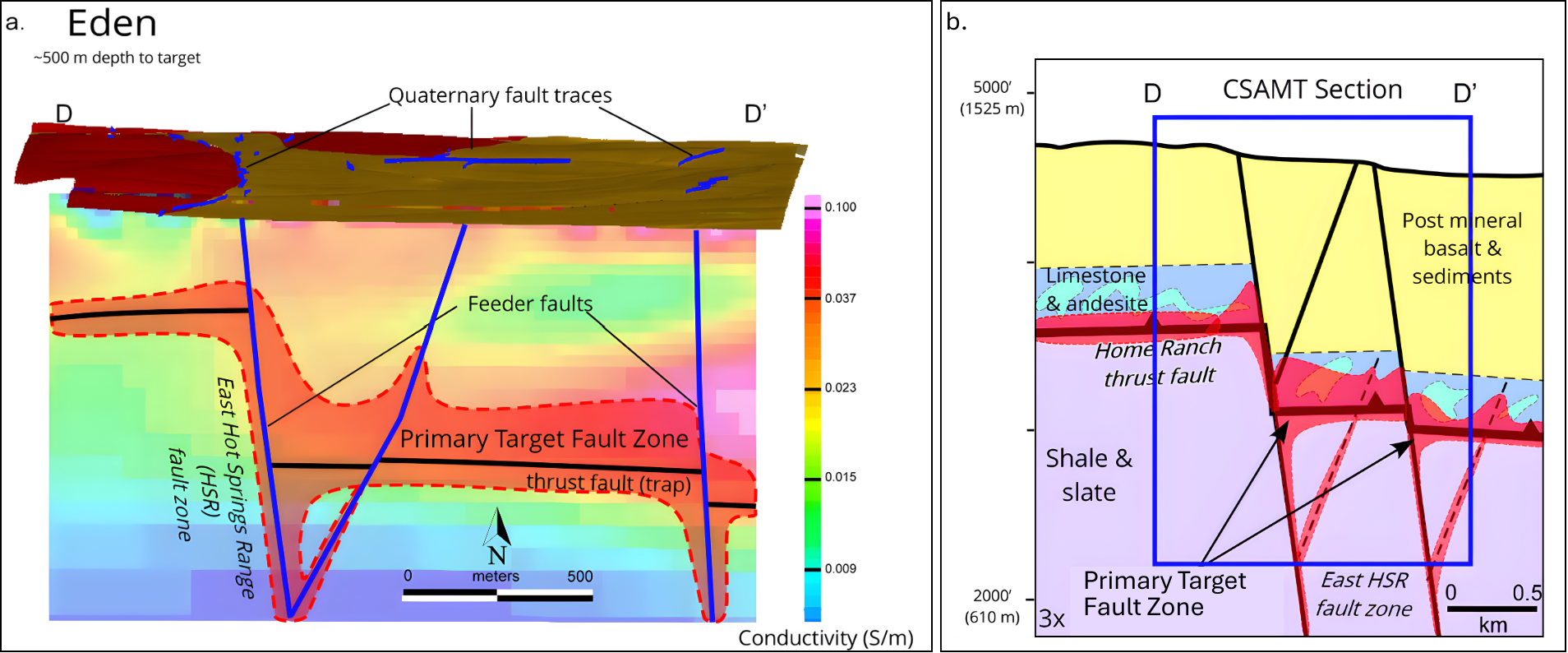
Eminent ran Controlled Source Audio‑Frequency Magnetotellurics (CSAMT) over both the Otis and Eden prospects (Figure 11). In the Eden area, the primary target was the edge of the Home Ranch Terrane, where it becomes covered by late, post‑mineral basalt. Both NE‑ and NW‑trending faults had been projected by Eminent’s geological mapping team. The CSAMT results indicate a graben‑ or half‑graben–style setting, where more conductive rocks have dropped down between steeper bounding faults.

In the Eden area, Eminent also completed CSAMT across several clearly defined Quaternary faults, including those marking the contact between Tvb basalt and Qal pediment. The data confirm the presence of steep faults forming a half‑graben, with potentially mineralized bedrock beneath either the pediment or the post‑mineral basalt (Figure 11). Overall, the results outline a series of half‑grabens with potentially mineralized bedrock.

Figure 11. Plan view simplified geologic map of the Hot Springs Range Project. in this instance, the limestone and andesite blocks of the HRT are mapped separately.  The black boxes define the areas of Otis and Eden target maps.  The crossed lines are the CSAMT survey.Figure 11. Plan‑view simplified geologic map of the Hot Springs Range Project. In this instance, the limestone and andesite blocks of the Home Ranch Terrane (HRT) are mapped separately. The black boxes outline the Otis and Eden target areas. The crossed lines show the CSAMT survey coverage.

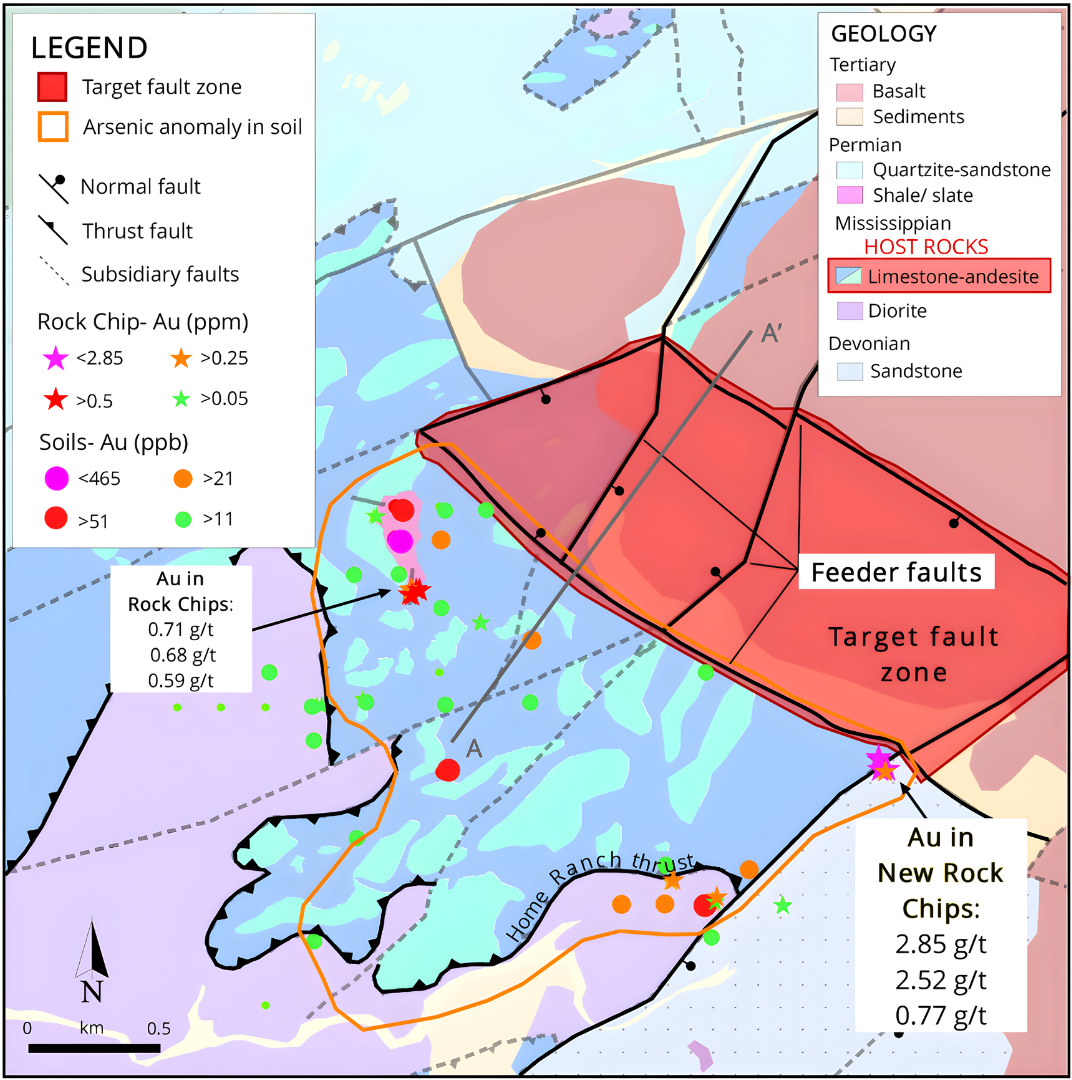
Figure 12.  Geology and highlight geochemical map with structural interpretation by the Eminent technical team showing the main target zone to be under the basalt coverFigure 12. Geologic and highlight geochemical map with structural interpretation by the Eminent technical team, showing that the main target zone lies beneath the basalt cover.

Figure 12.  Geology and highlight geochemical map with structural interpretation by the Eminent technical team showing the main target zone to be under the basalt coverFigure 13. Geologic and highlight geochemical map with structural interpretation by the Eminent technical team, showing that the main target zone lies beneath the basalt cover.

Figure 14. Plan view map of the Eden Target area with Quaternary fault scarps mapped via a digital terrain model. Soil samples (colored circles) were taken from the colluvial wedge formed by the faults. The intersection of the Eastern Hot Springs Range fault zone and the HSR-corridor faults is analogous to the intersection of the TR-corridor and Eastern Osgood Mountains fault zone at the Twin Creek deposit. The strongest geochemical anomalies at Eden occur immediately adjacent to this structural intersection along active fault scarps.Figure 14. Plan‑view map of the Eden target area with Quaternary fault scarps mapped using a digital terrain model. Soil samples (colored circles) were collected from the colluvial wedge formed by these faults. The intersection of the Eastern Hot Springs Range fault zone and the HSR‑corridor faults is analogous to the intersection of the TR‑corridor and Eastern Osgood Mountains fault zone at the Twin Creeks deposit. The strongest geochemical anomalies at Eden occur immediately adjacent to this structural intersection along active fault scarps.

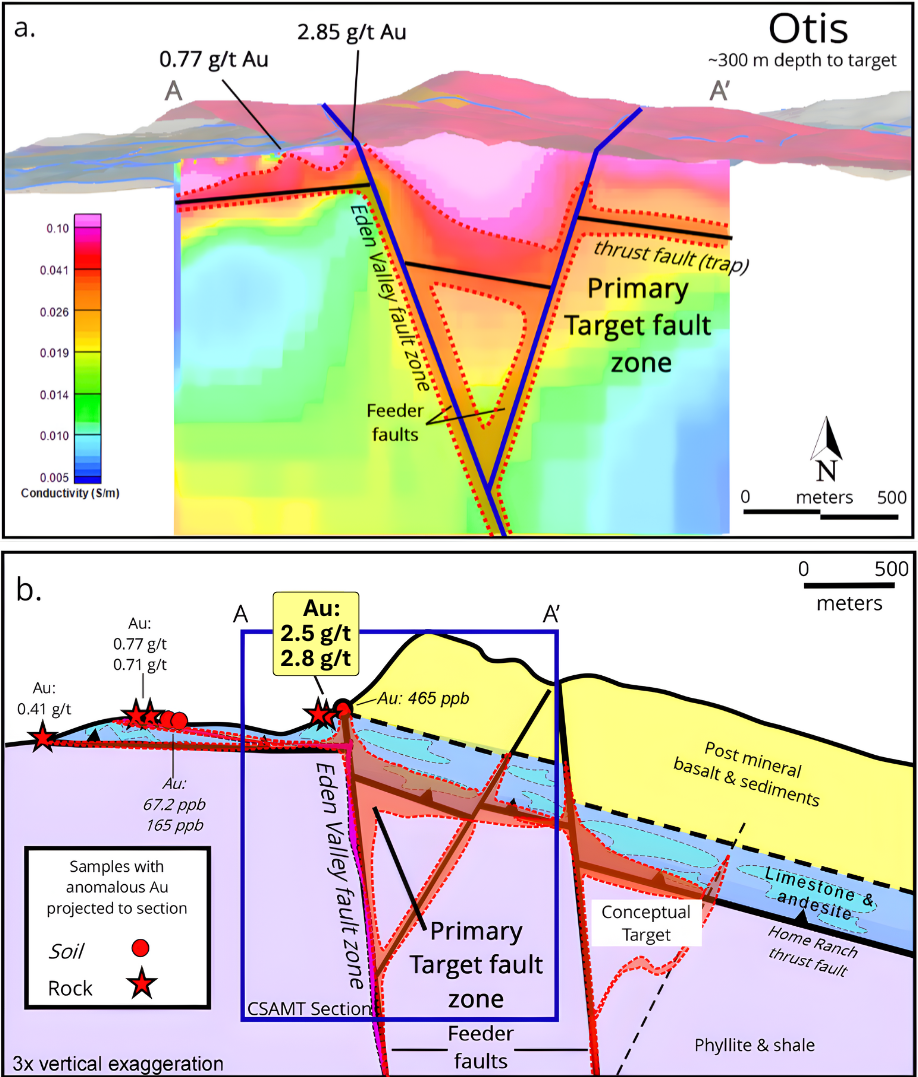
Figure 15. Cross section of the Eden target area, a) Oblique view of the CSAMT section in a Leapfrog model. Note the steeply dipping East Hot Springs Range fault zone and intersecting west-dipping faults, along with the shallow thrust fault. b) Conceptual cross section of the Eden target based on surface mapping and inferred subsurface geology showing the hypothesized fault geometry at depth as well as soil fault scarp samples projected to the section. The CSAMT data supports the existence of the conceptual faults at the Eden target.Figure 15. Cross‑section of the Eden target area.

a. Oblique view of the CSAMT section within a Leapfrog model. The section highlights the steeply dipping East Hot Springs Range fault zone, intersecting west‑dipping faults, and a shallow thrust fault.

b. Conceptual cross‑section of the Eden target based on surface mapping and inferred subsurface geology, showing the hypothesized fault geometry at depth and soil‑sample locations from fault scarps projected onto the section. The CSAMT data support the existence of the conceptual faults at the Eden target.

Core Drilling

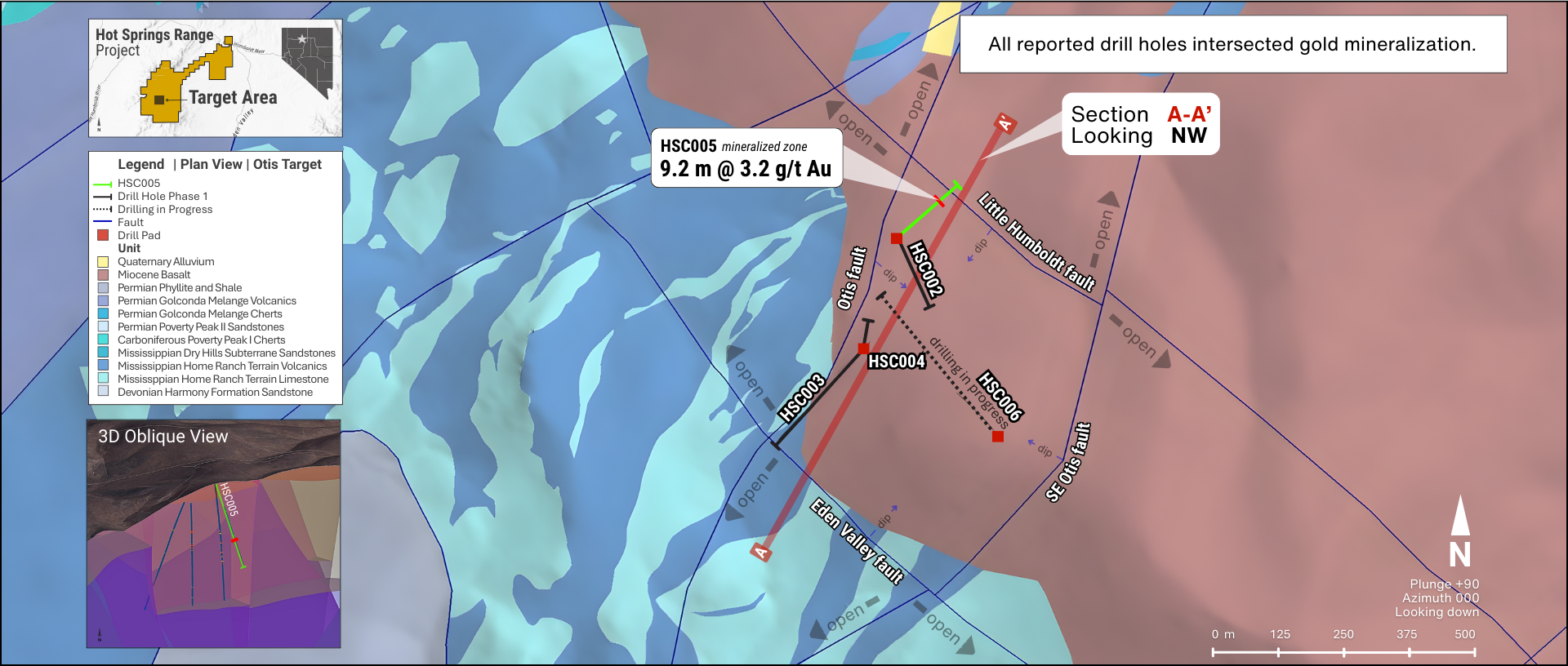
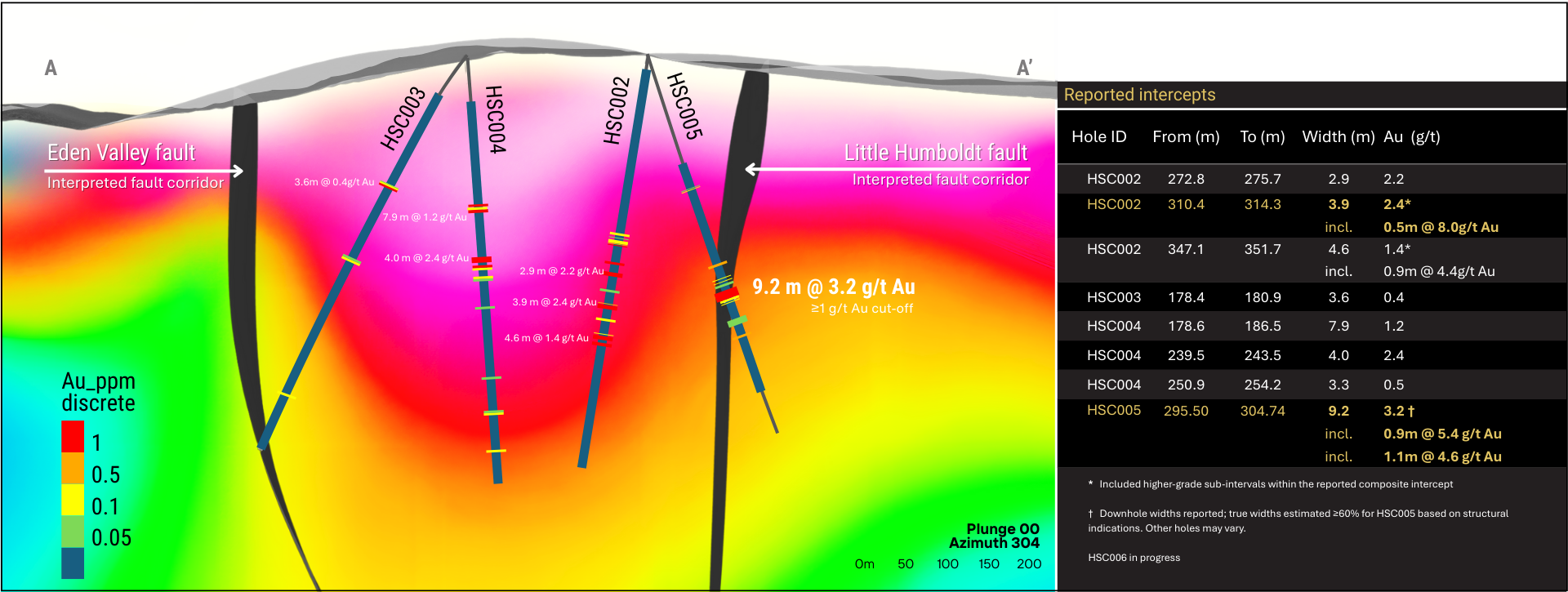
In 2025, Eminent completed four core holes to test the Otis structure and the Little Humboldt Fault (Figure 16). All four holes intersected gold mineralization, demonstrating that both the NE‑ and NW‑trending faults are carrying gold. These results validate the geology, geochemistry, and geophysics outlined in the previous sections.


Figure 16. The plan map shown in the top portion of the figure shows the location and traces of the four complete drill holes drilled by Eminent.  Because of weather limitations (drilling was mostly conducted in the winter months and the upper pad could not be reached), the drilling was limited to pads close to the Otis Fault so the drillholes were drilled obliquely to that fault and may not have completely crossed it.  Thus, the section in the lower part of the figure does not show the Otis fault as it is parallel to the fault.  However, HSC005 was drilled directly through the NW trending little Humboldt fault.  It was the best of the intercepts, delivering 9.2 m of 3.2 g/t (see all intercepts in the lower right of the figure.  The plan map shows hole shows HSC006, drilled from the top pad, which is in progress.  Note that this section is a different scale and has been interpreted slightly differently than the similar section in Figure 13 A and B due to new drilling information.Figure 16. The plan map in the upper portion of the figure shows the locations and traces of the four completed drill holes. Because drilling occurred primarily during winter and the upper pad was inaccessible, drilling was limited to pads near the Otis Fault. As a result, the holes were drilled obliquely to the fault and may not have fully crossed it. Consequently, the cross‑section in the lower portion of the figure does not show the Otis Fault, as the section is oriented parallel to it. In contrast, hole HSC005 was drilled directly through the NW‑trending Little Humboldt Fault and returned the best intercept: 9.2 m of 3.2 g/t Au (see all intercepts listed in the lower right of the figure). The plan map also shows hole HSC006, drilled from the upper pad, which is currently in progress. Note that this section is at a different scale and has been interpreted slightly differently than the similar section in Figures 13A and 13B due to new drilling information.

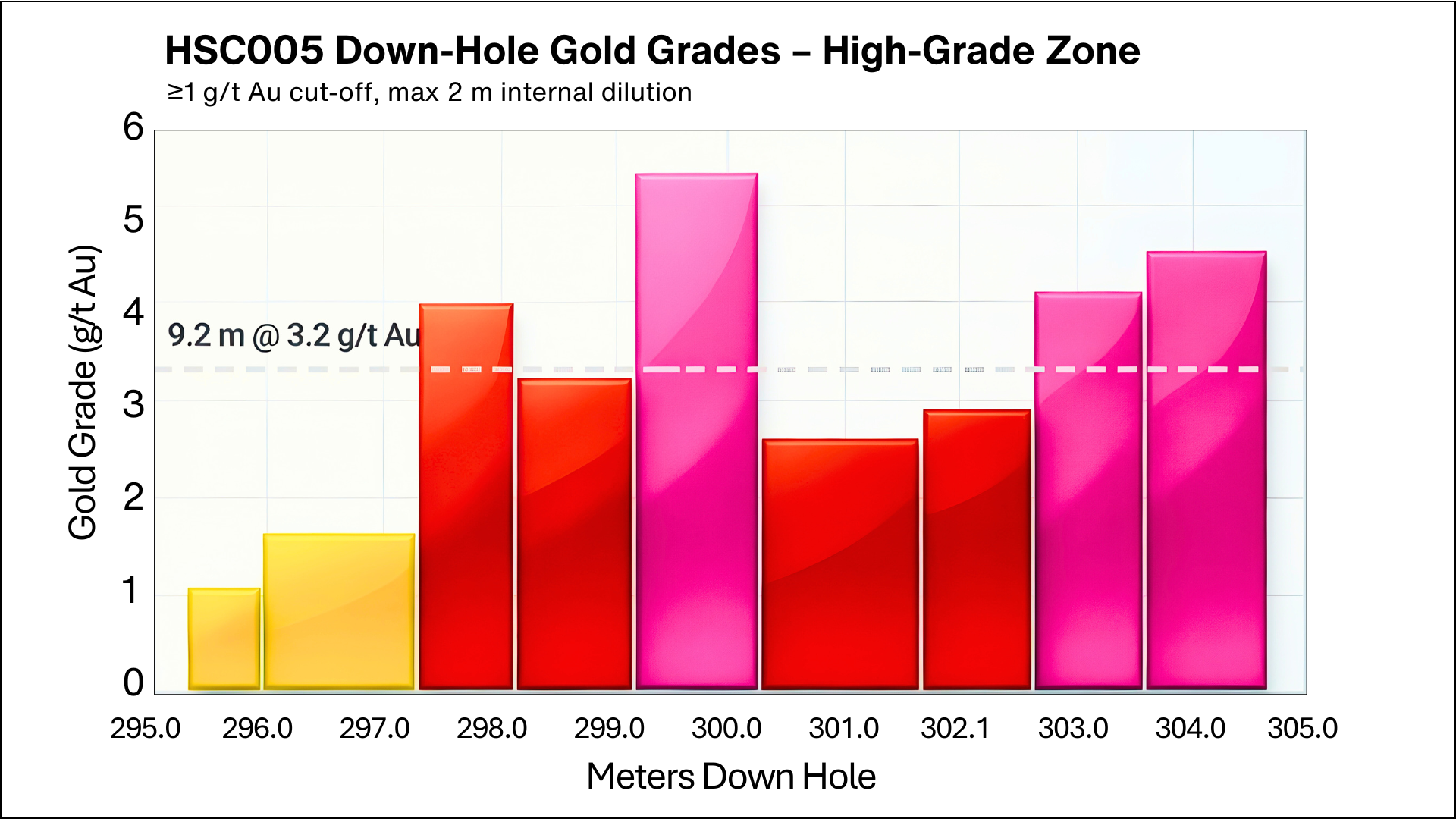
The hole confirmed the paragenesis of alteration and mineralization shown in Figure 9 and described in its caption. Figure 18 presents a bar graph of the sample grades within the intercept, illustrating that gold mineralization is evenly distributed throughout the interval.

Figure 17:  Core photos of the intercept assaying 3.2 g/t Au over 9.2 meters. The alteration of the rock consists of strong silica and illite/sericite replacement, which has decalcified the rock and completely destroyed the matrix of the original volcanic rock.  The highest-grade intervals have no quartz veins and thus Eminent’s technical team believes that the quartz veining may be a separate post-mineral event.Figure 17. Core photos of the interval assaying 3.2 g/t Au over 9.2 meters. The alteration consists of strong silica and illite/sericite replacement, which has decalcified the rock and completely destroyed the original volcanic matrix. The highest‑grade intervals contain no quartz veining, leading Eminent’s technical team to interpret the quartz veins as a separate, post‑mineral event.

Figure 19. Bar graph of the individual assays comprising the interval averaging 3.2 g/t Au over 9.2 meters of core length. The alteration consists of strong silica and illite/sericite replacement, which has decalcified the rock and completely destroyed the original volcanic matrix. The highest‑grade intervals contain no quartz veining, leading Eminent’s technical team to interpret the quartz veins as a separate, post‑mineral event.Figure 18. Bar graph of the individual assays comprising the interval averaging 3.2 g/t Au over 9.2 meters of core length. The alteration consists of strong silica and illite/sericite replacement, which has decalcified the rock and completely destroyed the original volcanic matrix. The highest‑grade intervals contain no quartz veining, leading Eminent’s technical team to interpret the quartz veins as a separate, post‑mineral event.

Building the Case for a New Carlin System

Eminent’s work to date has outlined a clear exploration path at HSRP. Mapping and geochemistry identified a strong host rock, gravity highlighted regional potential, and CSAMT defined the key mineralized structures at Otis and the potentially mineralized structures at Eden. Drilling at Otis returned solid gold intercepts, supporting the original thesis that HSRP may represent a new, potentially regional‑scale Carlin system.


To continue advancing this potential, Eminent plans a larger drill program at Otis and an initial drill program at Eden, following additional geophysical work. More results are coming.

Communities and the Environment

Eminent Gold is committed to environmentally responsible and socially conscious mineral exploration and potential development. We recognize the broad societal benefits that exploration and mining can bring, but only when the risks and impacts of land disturbance are carefully managed through thoughtful, sustainable practices. Eminent Gold strives to maintain the highest industry standards of environmental protection and community engagement across all of its projects.

We view sustainability as three mutually reinforcing pillars: protection of the environment and cultural heritage; support for social and community development; and the creation of economic opportunity. Eminent Gold evaluates the environmental, social, and financial benefits and risks of all business decisions, and we believe this commitment to sustainability creates value for local communities and shareholders alike.

Ownership Terms

Eminent holds 100% interest in 521 claims totaling >4,311 hectares at HSRP.

References

Bailey, E., and Phoenix, D., 1944, Quicksilver deposits in Nevada: Nevada Bureau of Mines and Geology Bulletin 41.

Dufresne, M., 2020, Technical Report for the Hot Springs Range Project, Humboldt County, Nevada, USA: Navy Resources.

Fiddes, C., Langhans, J., Schmiesing, P., Becker, J., Webber, T., Bottoms, S., 2025, NI 43‑101 Technical Report on the Turquoise Ridge Complex, Humboldt County, Nevada, USA, 304 pp.

Hays, R., 2019, Geologic Synergy Related to the Formation of Nevada Gold Mines: GSN Elko & Winnemucca November Meeting, Geological Society of Nevada.

Hays, R., 2004, The Cortez Hills Deposit: A Recent Discovery in an Historic Mining District, Lander County, Nevada: GSN Elko March Meeting, Geological Society of Nevada.

Johnson, R. D., and Muntean, J. L., 2018, Hydrothermal Features in Siliciclastic‑Volcanic Rocks above Carbonate‑Hosted High‑Grade Ore at the Turquoise Ridge Carlin‑Type Gold Deposit: Proceedings, Society of Economic Geologists Annual Meeting, Keystone, CO.

Jones, A. E., 1997, Geologic Map of the Hot Spring Peak Quadrangle and the Southeastern Part of the Little Poverty Quadrangle, Nevada: Nevada Bureau of Mines and Geology, scale 1:24,000.

Master, T. D., 2017, Technical Report on the Hot Springs Peak Gold Project, Humboldt County, Nevada, USA: Buena Vista Minerals Inc.

Mihalasky, M. J., 2001, Mineral Potential Modelling of Gold and Silver Mineralization in the Nevada Great Basin.

Milliard, J., and Schrantz, L., 2021, Eminent Gold Corp’s Four Nevada‑Based Exploration Projects: Geological Society of Nevada, November Elko Chapter Meeting.

Muntean, J. L., Cassinerio, M. D., Arehart, G. B., Cline, J. S., and Longo, A. A., 2009, Fluid Pathways at the Turquoise Ridge Carlin‑Type Gold Deposit, Getchell District, Nevada: in Smart Science for Exploration and Mining, Proceedings of the Tenth Biennial Meeting of the Society of Geology Applied to Mineral Deposits, Townsville, Australia, p. 251–252.

Roberts, R. J., 1966, Metallogenic Provinces and Mineral Belts in Nevada: Proceedings, AIME Pacific Southwest Mineral Industry Conference